
- Industries
- Water Treatment
- Focus topics
Legionella control in evaporative cooling systems – why monitoring makes all the difference
Contact person

Pascal Werder
Head of Business Unit Water Treatment
IMPAG AG
Open recirculating cooling towers often operate within a temperature range that supports Legionella proliferation. In addition, drift carries fine droplets into the surrounding air. Extended periods of high ambient temperature further intensify this situation. Systems run for longer, return temperatures rise, and the circulating water spends more time within the favourable growth range. The risk can be managed through two key measures, a biocide regime matched to the system and regular monitoring to verify that it is effective.
The system as a habitat for Legionella
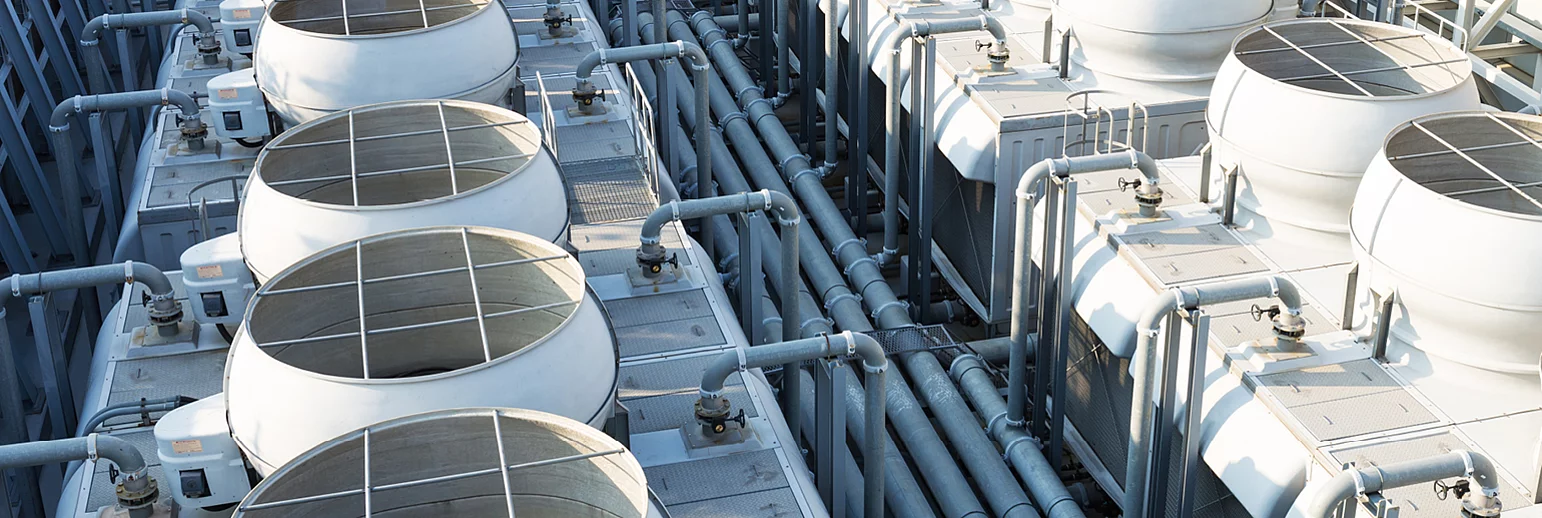
An open recirculating cooling tower rejects heat by evaporation. For much of the time, the circulating water remains within a temperature range that is favourable for Legionella pneumophila, approximately 25 to 45 degrees. At the same time, evaporation concentrates dissolved solids as cycles of concentration increase, the make-up water introduces nutrients, and the air-scrubbing effect of the tower carries organic material from the surrounding environment into the circuit. From a microbiological perspective, a cooling tower is therefore a well supplied habitat.
With extended periods of high ambient temperature, operating hours increase and return temperatures rise. As a result, the circulating water spends more time within the favourable growth range. A treatment programme designed several years ago is therefore not automatically still fit for today's operating conditions.
A further point to consider is exposure. An evaporative cooling system releases fine water droplets into the air during operation. The route of transmission to humans is via precisely these aerosols, which can be inhaled and, depending on weather conditions, may spread beyond the immediate vicinity of the plant. Added to this is the exposure of the operator's own staff, who come into direct contact with the circulating water during maintenance, cleaning and sampling.
Where Legionella bacteria multiply
Legionella proliferate in water systems predominantly within certain free-living amoebae and other protozoa. These commonly reside in biofilms. Although Legionella can survive in open, nutrient-poor water, they generally multiply only to a limited extent there.
In practical terms, this means that Legionella are partially shielded within the system, both by the biofilm matrix and by the host cell. This explains why they respond differently to biocides than planktonic bacteria, and why the condition of the biofilm is a key factor in determining the effectiveness of a treatment programme.
What makes a biocide strategy effective for Legionella control
An active substance exerts its effect where it reaches the target site in sufficient concentration and for a sufficient contact time. Four factors determine this.
- Choice of active agent
Oxidising and non-oxidising biocides have different strengths. Oxidising biocides have a broad spectrum of action and act quickly, while non-oxidising biocides reach areas that oxidants penetrate poorly. - Contact time and dosing strategy
What matters is the interaction between concentration and contact time. A slug dose behaves differently from continuous dosing, and the choice depends on system volume, holding time and blowdown rate. - pH control
With oxidising biocides, the pH value determines which active species is present. Operating within the pH range recommended for the respective programme is therefore just as important as the dosage itself. - Access to the biofilm
Dispersants keep biological deposits and sludge in suspension so that they are removed via blowdown, allowing the active substance to reach the remaining deposits more effectively.
Added to this is the overall cleanliness of the circuit. Organic load and reduced species exert oxidant demand before the active substance reaches its target, while scale and corrosion products provide the biofilm with additional surface area and shelter. Conditioning of the circuit is therefore not a separate issue alongside hygiene, it is its foundation.
Operating conditions that are often overlooked belong in the same picture. Standby cells, extended shutdown periods and recommissioning lead to stagnation at temperatures within the favourable growth range. A programme should account for these conditions, not only for normal operation.
Monitoring, turning assumptions into evidence
A treatment programme is only as good as the evidence that it is working. Regular monitoring provides that evidence and makes changes visible before they become a problem.
The parameters that can be monitored continuously or at short intervals are free oxidant residual, pH value, cycles of concentration, conductivity, turbidity and total viable count. These are the parameters you steer by, since even small shifts indicate that conditions within the circuit are changing.
Legionella testing complements this as periodic verification. Culture remains the reference method but typically requires seven to ten days of incubation. Molecular methods deliver results considerably faster, but they detect genetic material and therefore also non-viable cells. They are suited to rapid orientation and to trend analysis, but they do not replace culture confirmation. It should also be borne in mind that Legionella can enter a viable but non-culturable state, in which culture underestimates their presence.
Representativeness matters just as much. Legionella are distributed unevenly across the system and episodically over time. A single sample describes one sampling point at one moment, not the condition of the plant. Meaningful conclusions emerge from a measurement series.
Sampling itself is part of the method. Sampling point, neutralisation of residual oxidant in the sample vessel, temperature control and transport time all determine how robust the result is.
Responsibility and Documentation
Evaporative cooling systems are not subject to a general notification requirement in Switzerland. Responsibility for hygienically sound operation therefore lies with the operator. Operators who know their systems, who can demonstrate the history of water quality and who document the measures taken are in a position to act with confidence towards authorities, insurers and within their own quality management system. This documentation cannot be produced retrospectively, it is generated through regular monitoring.
Our proven approach to legionella control
IMPAG Water Treatment covers the water side. This includes on-site sampling, analysis of the circulating water, Legionella testing through our accredited partner laboratory, a written assessment with recommendations for action, the biocide and conditioning programme, product supply and training for operating staff.
Mechanical cleaning and disinfection of the plant, together with plant engineering including drift eliminators, are outside our scope and remain with your existing partner. The division of tasks makes sense. Mechanical cleaning removes existing fouling, water chemistry keeps it from returning.
The three-stage cooling tower check
We have structured the cooling tower check into three stages so that you can choose the scope that best suits your system and your current situation.
- Baseline assessment:
A one-off evaluation of your system's current status. On-site sampling, analysis of the circulating water, Legionella testing through our accredited partner laboratory, a written report with recommendations for action, and a discussion of the results. You then know where your system stands. - Monitoring
Carried out at intervals based on the risk profile of the system. In addition to the baseline assessment, you receive a trend analysis based on the measurement series and an annual summary for your operator documentation. You see changes before they become a problem. - Support:
Ongoing management of the circuit. In addition to monitoring, we manage the biocide and conditioning programme, product supply and staff training, and respond to anomalies within agreed timeframes. You hand over the water side while retaining control over it.
Legionella control in cooling circuits calls for specialist knowledge that is not acquired on the side. That is exactly why we are here. You retain control of the system and its operation, and gain the assurance that your programme is demonstrably effective.
Take the first step with a free on-site consultation. One hour is usually sufficient to review your current situation and existing documentation, and to determine together which systems require a more in-depth assessment. There is no obligation, and no preparation is required on your part.