

Contact person

Cyrill Husmann
Sales & Product Manager Food
IMPAG AG
Modern food and beverage products must deliver more today than ever before: stable textures, appealing sensory properties, and reliable performance throughout their entire shelf life. This is exactly where functional hydrocolloids like xanthan and gellan come into play, enabling precise control over these characteristics.

Overview: Xanthan and Gellan
Xanthan and gellan are among the central hydrocolloids in modern food and beverage development when it comes to the targeted adjustment of viscosity, stability, and structure. Even in low usage levels, they allow for precise control of flow behavior, particle suspension, and texture—even under demanding process and storage conditions. Thus, they form a reliable technological foundation for consistent and functional product concepts.
Both substances are microbially produced polysaccharides with high functional performance in aqueous systems. They are manufactured through fermentation from renewable raw materials and are among the most important hydrocolloids in the food, beverage, supplement, and pharmaceutical-related industries. While xanthan is primarily used to build viscosity and stability, gellan enables targeted structuring up to defined gel formation. In combination, both systems offer a wide technological spectrum—from liquid applications to structured systems.
The following sections examine both hydrocolloids in detail and categorize them according to their functional properties and application possibilities.
Xanthan in a nutshell
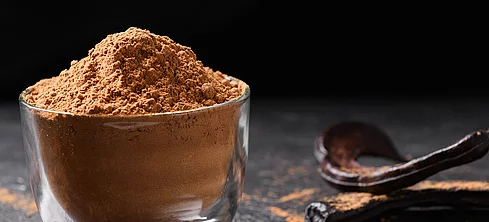
Xanthan is a white to cream-colored, free-flowing powder with a neutral taste and very high functional efficiency. It is soluble in both cold and hot water and is characterized by a rapid build-up of viscosity even at low dosages. A key feature is its pronounced pseudoplastic behavior (shear thinning), which causes the viscosity to decrease under shear stress and recover very quickly once the stress is removed.
Furthermore, Xanthan is highly stable across pH fluctuations—from acidic to alkaline conditions—as well as against thermal stress and salts. In addition, Xanthan provides excellent suspension stabilization and improves the mouthfeel, flow, and cling properties of final products. Typical examples include salad dressings, where Xanthan simultaneously ensures stable emulsions and optimal flow behavior, or protein-rich beverages, where sedimentation is significantly reduced.
Available qualities:
- Different particle sizes
- Various viscosity levels
- Easily dispersible / instantized types
- Dust-free variants
- Clear solution qualities
- Salt-tolerant and acid-stable types
The selection of the appropriate quality usually depends on process conditions, desired texture, and the dispersion behavior in the respective end product.
Gellan in a nutshell
Gellan is a hydrocolloid that functions by forming a finely cross-linked polymer network within aqueous systems. Gel formation is typically supported by ions, such as calcium, allowing for precise control over texture and stability even at very low dosages.
In contrast to xanthan, which primarily acts as a viscosifier, the focus with gellan is on targeted structuring and gel formation. Depending on the type, different texture profiles can be realized: High Acyl Gellan forms elastic, soft gels with a rather creamy character, while Low Acyl Gellan enables firm, more brittle gels for precise structuring.
In application, gellan usually requires ions such as calcium for gel formation, whereby both thermoreversible and stable systems can be realized. At the same time, it is excellent for suspensions, as it can stabilize particles without significantly increasing the viscosity of the system.
Comparison of Gellan types
Depending on the application and desired texture profile, different types of gellan are available, which differ in functionality and area of application.
| Property | High Acyl (HA / HA-D) | Low Acyl (LA) | Modus – Jungbunzlauer Innovation |
|---|---|---|---|
Product requirement | Suspension & stability; Homogeneous, flowable texture; good processability; storage stability | Transparent applications; processing at lower temperatures; water-like flowability; good flavor release | Structured beverages; premium look (clear) |
Functional advantages | Fluid gel at low dosage; soft, elastic gels; thermoreversible; non-transparent | Strong gel formation; high clarity; freeze- & heat-stable; low gelling temperature | Elastic, firm, slightly brittle; very high clarity; thermoreversible |
Typical applications | Dairy & plant-based drinks, yogurts, custards, ice cream, functional drinks | Clear beverages, bakery products, confectionery, fruit preparations | Gel desserts, premium water with inclusions |
Ion sensitivity | Low | High (Ca²⁺ / Mg²⁺ required) | Moderate |
Gelling temp. | ~60–80 °C | ~35–45 °C | ~60–80 °C |
Gel structure | Soft, elastic | Firm, brittle | Elastic, firm, slightly brittle |
Gel formation | Possible without cations | Requires cations | Possible without cations |
Suspension (liquid) | Weak, reversible network | Strong, non-reversible network | Weak, reversible network |
Heat stability (Gel) | Reversible (melts) | Not reversible | Reversible (melts) |
Freeze stability | Gel strength decreases | Very stable | Gel strength decreases |
Clarity | Turbid | Clear | Very clear |
Simplified: High Acyl for creamy and soft systems, Low Acyl for clear and structured applications, and Modus for innovative, visually differentiating concepts.

Application areas of Xanthan and Gellan
The following application areas demonstrate typical uses for Xanthan and Gellan, as well as their respective technological added value.
| Application Area | Xanthan | Gellan |
|---|---|---|
Dairy (Dairy & Alternatives) | Stabilizes cocoa, protein & minerals; Improves mouthfeel (esp. fat-reduced); Viscosity build-up without gel structure.Typical products: Chocolate milk, protein milk, drinkable yogurt, plant-based drinks (oat, soy). | Efficient suspension at very low dosage; Prevents phase separation without high viscosity.Typical products: Chocolate milk, Ready-to-Drink protein shakes, Barista plant drinks. |
Beverages (Soft drinks, functional drinks) | Stabilizes fruit fibers & functional ingredients; Excellent in acidic systems (pH-stable); Specifically increases viscosity.Typical products: Fruit juice drinks, smoothies, energy drinks with add-ons. | Industry standard for clear particle suspension; Almost no change in viscosity; Very high optical clarity.Typical products: Vitamin water with particles, clear protein or collagen drinks, botanical drinks. |
Convenience (Sauces, dressings, ready meals) | Emulsion stabilization (oil/water); Controlled flow behavior (shear thinning); High process stability (heat, shear).Typical products: Salad dressings, BBQ sauces, mayonnaise alternatives, ready-made sauces. | Structuring of individual phases; Thermally stable gels (e.g., inclusions).Typical products:Sauces with vegetable/herb inclusions, structured ready meals. |
Bakery Products | Improves dough stability (esp. gluten-free); Increases water binding & freshness; Supports volume & crumb.Typical products: Gluten-free bread, muffins, cakes, tortillas. | Stabilizes fillings & fruit preparations; Defined gel structure possible.Typical products: Fruit fillings, bake-stable gels, glazes. |
Desserts / Jellies | Viscosifier for creamy systems; Prevents syneresis; No independent gel – usually combined with other hydrocolloids.Typical products:Pudding, cream desserts, fruit preparations, dessert sauces. | Forms defined gel structures (soft to firm); Thermoreversible (depending on type); Excellent water binding & clear gels possible.Typical products: Jellies, fruit gels, jelly desserts, gel layers, gel inclusions. |
Tip: In certain applications, xanthan and gellan are also specifically combined to optimally adjust both viscosity and structure and to take advantage of synergistic effects.

Sustainability & Origin
A central added value lies in the European production by Jungbunzlauer. Sustainability is an essential part of the corporate strategy: the products are manufactured through natural fermentation based on renewable raw materials and are easily biodegradable.
For customers, this results in clear advantages: reliable European production, high delivery security, reduced CO₂ impact due to shorter transport routes, and consistently high product quality. This is becoming increasingly important, particularly against the background of rising requirements for sustainable supply chains and transparent raw material origins.
Jungbunzlauer
Jungbunzlauer is one of the world's leading manufacturers of biodegradable natural ingredients. The company is headquartered in Switzerland, with production sites for the European market in Germany, France, and Austria. Jungbunzlauer specializes in the production of citric acid, xanthan, gellan, lactic acid, gluconic acid, mineral salts, as well as specialties and sweeteners. The products are used across a wide range of functions in various foods and beverages.
Conclusion
Xanthan and Gellan form a flexible and powerful foundation for the development of modern, stable, and differentiated product concepts. Through their complementary functional properties, they enable precise control of texture, stability, and sensory properties making them central tools for innovative applications in the food and beverage industry.