- Industries
- Performance Chemicals
- Focus topics
CERAFLOUR-1053, the newest member of the CERAFLOUR-1050 family
Contact person

Tais Arp
Dirección Asesoría Técnico Comercial
IMPAG IBERIA, S.L.
A new PTFE- and microplastic-free wax additive providing excellent abrasion and scratch resistance, as well as slip properties, for water-borne, solvent-borne and UV-curable systems.
PTFE is a typical example of per- and polyfluoroalkyl substances (PFAS), also known as “forever chemicals”, which are the subject of intense debate due to their persistence, mobility and potential toxicity. These substances can accumulate in the environment, humans and animals without breaking down.
For this reason, BYK ceased production and shipment of additives containing PFAS at the end of 2025, as part of its commitment to a more sustainable future.
However, PTFE-based wax additives possess unique properties that other materials cannot offer. They provide outstanding abrasion and scratch resistance, making their replacement in coatings a significant challenge.
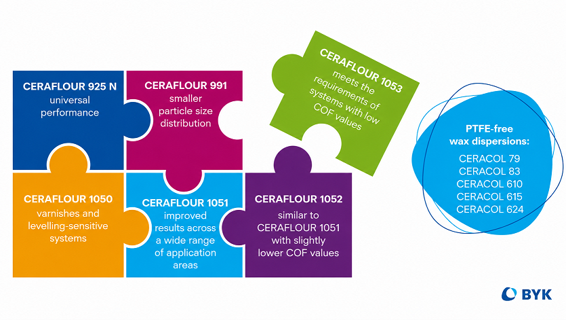
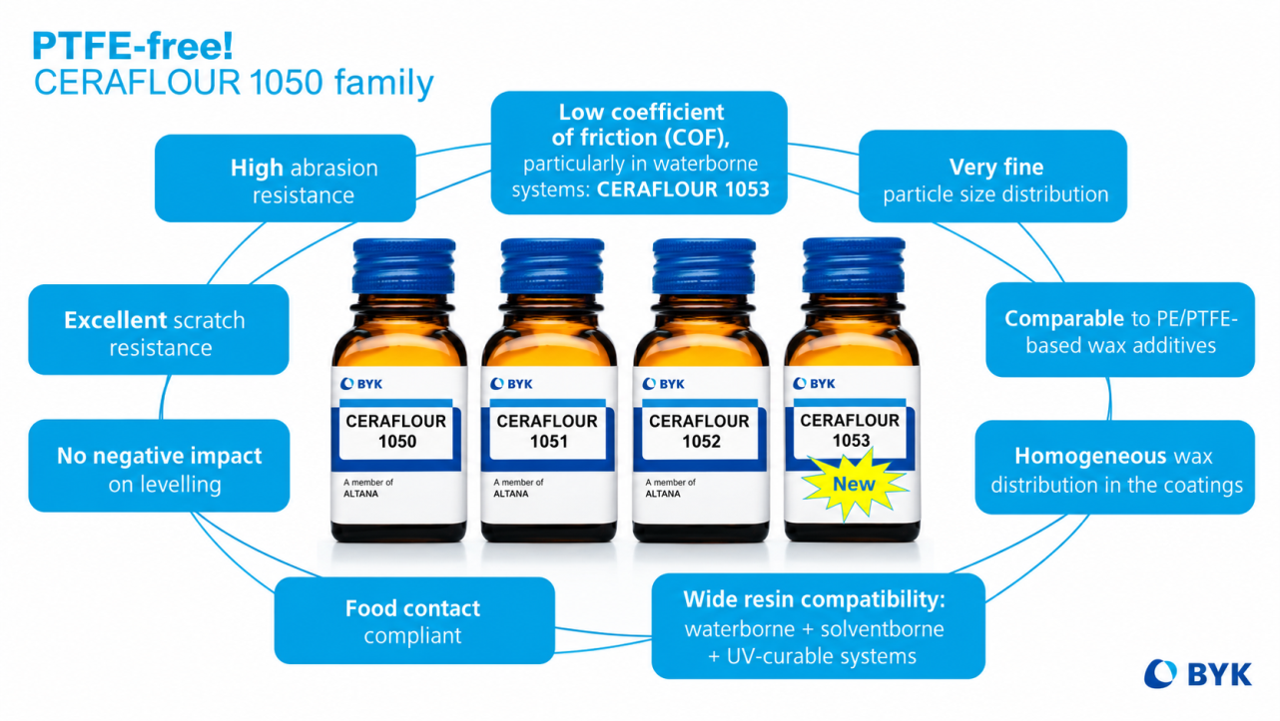
BYK has developed sustainable alternatives to PE/PTFE-based wax additives that are safe to use and deliver excellent application performance: the CERAFLOUR-1050 family.
In some systems, CERAFLOUR 1050, 1051 and 1052 provide good scratch and abrasion resistance, but their coefficient of friction (COF) values are not acceptable. In the can coatings sector in particular, coatings may require a low COF value in addition to good scratch and abrasion resistance.
The new CERAFLOUR-1053 therefore completes the family, not only improving scratch and abrasion resistance but also significantly reducing the coefficient of friction (COF), particularly in water-borne systems.
Furthermore, this new wax additive is completely free from microplastics, making it an excellent sustainable alternative to conventional PE-based wax additives in systems where the presence of such materials is not permitted. It is also approved for food-contact applications.
We particularly recommend its use in can coatings, industrial coatings, wood and furniture coatings, architectural coatings and printing inks.
CERAFLOUR-1053 is a blend of micronised Fischer–Tropsch and carnauba waxes, with a melting point of 115 °C and an average particle size of 6 µm. It has little or no effect on the final gloss of coating systems.
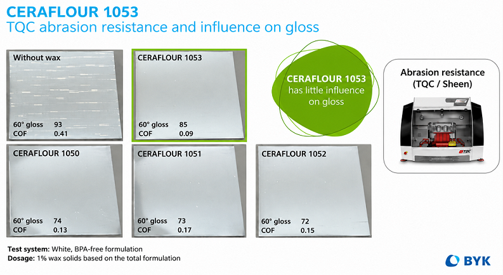
Let us consider a practical example involving a solvent-borne can coating (Figure 2). Results obtained with a white, BPA-free internal coating show that all the products provide similar abrasion resistance when tested using TQC Sheen equipment. However, the new CERAFLOUR-1053 achieves the lowest COF and also has less impact on gloss:
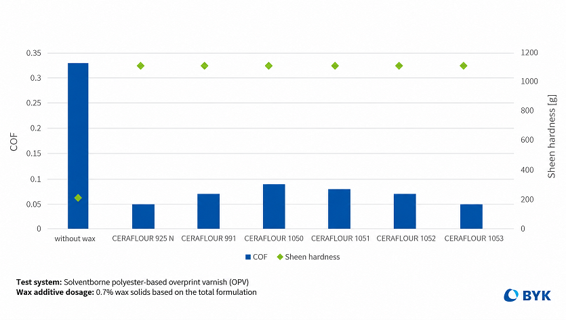
Now let us examine the Sheen hardness and COF results obtained with an overprint varnish (OPV). In this case, all products in the CERAFLOUR-1050 family may be suitable options, however, the new CERAFLOUR-1053 achieves the lowest COF:
Finally, let us consider an example involving a water-borne OPV for can coatings. Existing products in our portfolio provide good scratch resistance, but their COF values are often too high for this sector. Here, CERAFLOUR-1053 combines an excellent reduction in COF with good scratch and abrasion resistance.
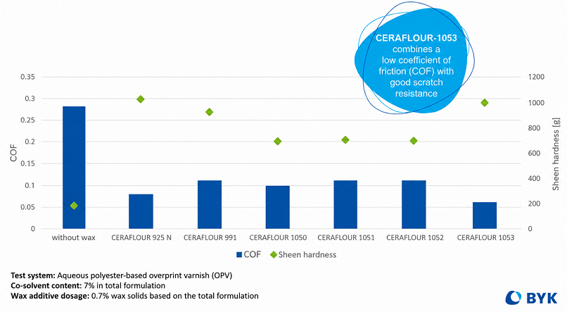
In water-borne systems, we recommend an organic co-solvent content of at least 5-10% to prevent the wax additive from floating.
These wax additives can easily be incorporated into coatings at medium shear rates at the end of the production process (during the let-down stage). The temperature should be kept below 40 °C to prevent the wax particles from swelling. CERAFLOUR-1053 can also be pre-dispersed in organic solvents or in a mixture of these solvents and the resins used in the coating formulation, if this facilitates incorporation during production. However, it should not be pre-dispersed in water. A typical pre-dispersion concentration would be between 15% and 25% CERAFLOUR-1053.
In all cases, we recommend confirming the storage stability of the final system.
In conclusion, BYK offers a wide range of options for replacing standard PE/PTFE-based wax additives. The newest member of the family, CERAFLOUR-1053, now also provides a microplastic-free micronised wax additive option that combines good scratch and abrasion resistance with low COF values.